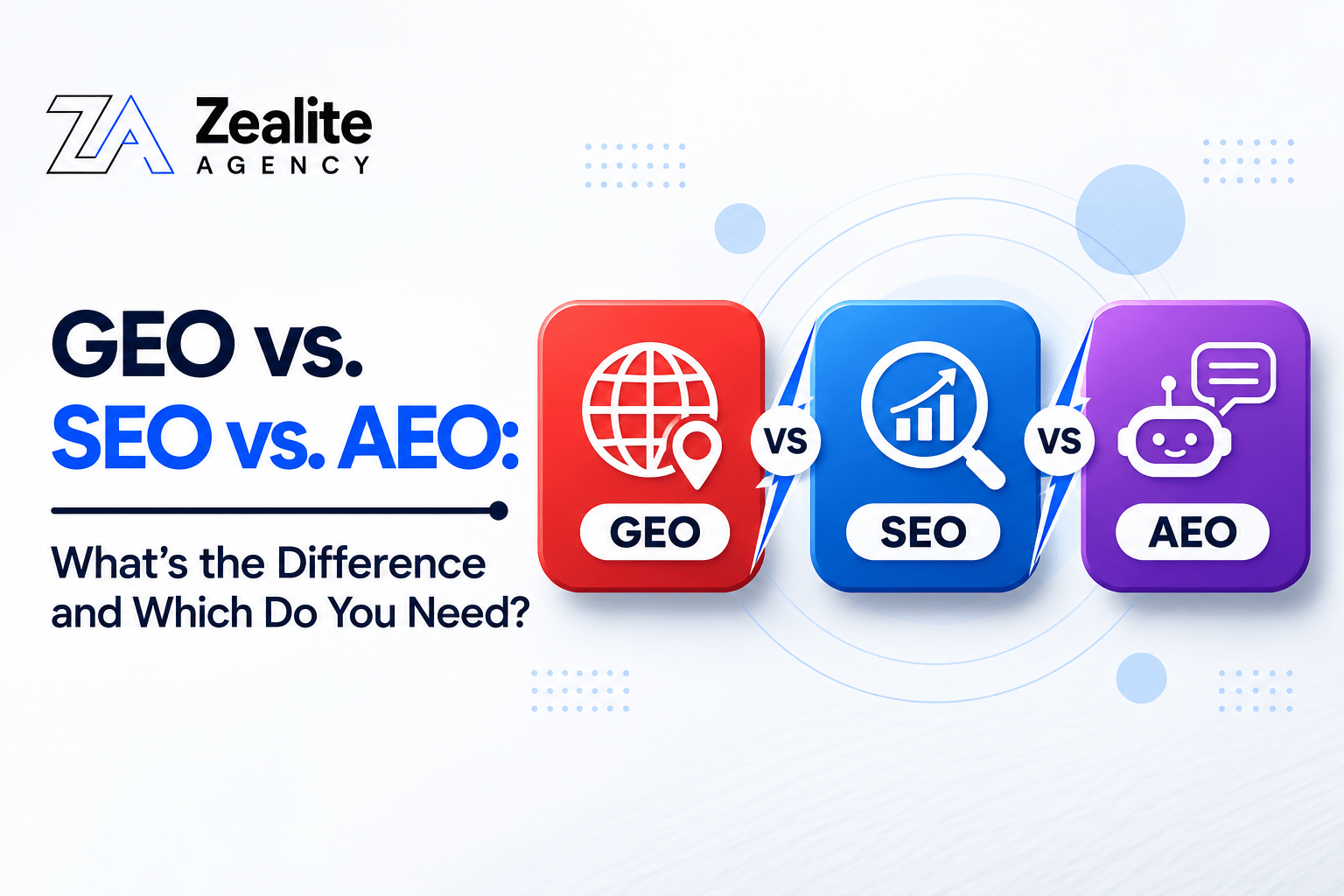
Search behaviour is changing as people move beyond traditional Google searches to find information. Today, they also use AI tools, voice assistants, and conversational search platforms to explore services, compare businesses, and get quick answers. This shift is changing how brands approach online visibility and connect with potential customers.
In this blog, we will explore GEO vs. SEO vs. AEO, how each approach works, their key differences, and when businesses should use them. We will also discuss how these strategies can work together to improve search visibility, attract relevant audiences, and build trust across different search platforms.
What is SEO (Search Engine Optimization)?
Search Engine Optimization (SEO) improves a website’s visibility in organic search results by helping search engines understand its content and relevance to user queries.
For example, when someone searches for a digital marketing agency, Google evaluates websites to identify useful and relevant pages. SEO helps businesses rank higher and attract organic traffic.
How Does SEO Work?
SEO involves four main activities:
1. Keyword Research
Identifies the search terms people use to find products, services, or information, helping businesses understand search behaviour.
2. On-Page SEO
Improves individual website pages through:
- Relevant title tags and meta descriptions.
- Proper H1, H2, and H3 heading structure.
- Natural keyword placement.
- Helpful content and internal linking.
- Image optimization and descriptive alt text.
3. Technical SEO
Ensures search engines can access and understand your website through:
- Website speed and mobile friendliness.
- XML sitemaps and crawlability.
- Indexability and website security.
- Structured data implementation.
4. Off-Page SEO
Builds website authority through quality backlinks, brand mentions, useful resources, and relevant business listings.
When Should Businesses Focus on SEO?
SEO helps businesses improve industry visibility, attract potential customers, build authority, increase organic traffic, and generate leads over time.
Businesses considering an experienced SEO company in USA should understand these fundamentals when evaluating an agency’s approach and long-term strategy.
What is AEO (Answer Engine Optimization)?
Answer Engine Optimization (AEO) makes website content easier for search platforms and digital assistants to understand and present as direct answers.
While traditional SEO focuses on search visibility, AEO prioritizes clear and accurate answers to specific questions.
For example, users might ask:
- What is the difference between SEO and digital marketing?
- How much does website optimization cost?
- Which marketing strategy suits a small business?
- How can a company improve its Google rankings?
Search platforms provide answers through featured snippets, knowledge panels, voice search results, and other answer-focused experiences.
How Does AEO Work?
AEO focuses on clear information and well-organized content.
1. Answer Questions Directly
Provide a clear answer before adding further details. For example, define “Local SEO” before explaining its benefits.
2. Use Question-Based Headings
Organize content around common questions, such as:
- What Does SEO Mean?
- Why Is Website Speed Important?
- How Does Local Search Work?
- When Should a Business Invest in SEO?
This helps readers and search systems find relevant information.
3. Add Structured Data Where Relevant
Use appropriate schema markup for products, services, organizations, and articles to help search engines understand webpage information. However, schema does not guarantee featured snippets or rich results.
4. Create Useful FAQs
Answer common customer questions with concise, accurate information rather than adding questions just for keywords.
When Should Businesses Focus on AEO?
AEO is useful for educational websites, professional service providers, healthcare and financial information websites, SaaS businesses, and companies targeting question-based searches.
For example, businesses offering paid advertising solutions may need to explain campaign costs, targeting, and processes. Recognizing when to hire PPC experts can also help address common questions about paid search campaigns.
What is GEO (Generative Engine Optimization)?
Generative Engine Optimization (GEO) focuses on improving a brand’s visibility in AI-generated responses. It helps generative AI platforms discover, understand, and potentially reference useful business information.
Platforms such as ChatGPT, Google AI Overviews, and Perplexity allow users to ask detailed questions and receive summarized responses instead of browsing multiple websites.
For example, someone might ask, “Which digital marketing agencies help small businesses improve their online visibility in the United States?”
GEO aims to make website and brand information clear, useful, credible, and understandable to these platforms.
How Does GEO Work?
GEO involves creating informative content with reliable information and sufficient context.
1. Publish Original and Informative Content
Share original research, practical examples, industry insights, and detailed explanations instead of repeating common advice.
2. Build Brand Authority
Clearly communicate your services, target industries, and expertise. Consistent business information, credible references, and relevant brand mentions help establish authority.
3. Use Clear and Contextual Information
Avoid vague statements. Explain your services, who they help, and the problems they solve.
4. Support Claims With Reliable Sources
Use trustworthy references for statistics, research findings, and industry developments so readers can verify important information.
5. Maintain Consistent Brand Information
Keep your website, service pages, business profiles, and other online sources consistent to avoid confusion across platforms.
When Should Businesses Focus on GEO?
GEO is particularly relevant for businesses targeting audiences who use AI-powered search and research tools.
It can benefit:
- Brands competing in information-rich industries.
- Businesses offering specialized products or services.
- Companies whose customers compare multiple providers.
- Organizations publishing research and educational content.
- Businesses seeking visibility beyond traditional search results.
However, GEO cannot guarantee mentions or recommendations from AI platforms. Each platform uses different systems, sources, and selection methods.
Suggested read: How an SEO Company Helps Your Brand Stand Out Online
GEO vs. SEO vs. AEO: Key Differences Explained
Although GEO, SEO, and AEO overlap in several areas, their main objectives and search environments are different.
Understanding the difference between GEO, SEO and AEO makes it easier to decide where your content and optimization efforts should be focused.
Here is a closer comparison.
1. Primary Goal
Each strategy has a different objective when it comes to helping users discover information.
- SEO: Improves website rankings in traditional organic search results and attracts relevant visitors.
- AEO: Makes content suitable for direct answers provided by search engines and digital assistants.
- GEO: Helps AI platforms understand and potentially reference a brand or its content in generated responses.
2. Main Search Platforms
These strategies focus on different platforms where users search for information.
- SEO: Targets traditional search engines such as Google and Bing.
- AEO: Focuses on featured snippets, voice assistants, and answer-focused search experiences.
- GEO: Targets generative platforms such as ChatGPT, Perplexity, and Google AI Overviews.
3. Content Approach
Content is important for all three strategies, but each requires a slightly different approach.
- SEO: Focuses on relevant keywords, search intent, informative content, and proper website structure.
- AEO: Prioritizes clear answers, question-based headings, FAQs, and concise explanations.
- GEO: Emphasizes original insights, detailed context, factual accuracy, and credible sources.
4. How Success is Measured
Businesses can evaluate each strategy through different performance indicators.
- SEO: Organic traffic, keyword rankings, impressions, clicks, and conversions.
- AEO: Featured snippet visibility, answer appearances, and referral traffic where measurable.
- GEO: AI platform mentions, content citations, referral visits, and brand visibility in generated responses.
5. Long-Term Value
Each approach supports online growth differently.
- SEO: Builds sustainable organic visibility through regular website and content improvements.
- AEO: Helps users discover useful information when searching for specific answers.
- GEO: Strengthens brand awareness and discoverability across AI-powered search experiences.
The following comparison summarizes GEO vs. SEO vs. AEO:
| Factor | SEO | AEO | GEO |
|---|---|---|---|
| Full Form | Search Engine Optimization | Answer Engine Optimization | Generative Engine Optimization |
| Main Goal | Improve organic rankings. | Provide direct answers. | Improve AI search visibility. |
| Primary Focus | Search rankings and traffic. | Clear, question based answers. | Brand authority and AI visibility. |
| Target Platforms | Google, Bing. | Featured snippets, voice search. | ChatGPT, Perplexity, Google AI Overviews. |
| Content Approach | Keyword focused content. | FAQs and concise answers. | Detailed, credible content. |
| Key Techniques | Keyword research, technical SEO, link building. | Structured content, FAQs, schema markup. | Original research, brand mentions, reliable sources. |
| Success Measurement | Rankings, traffic, conversions. | Answer visibility, snippets, referrals. | AI mentions, citations, referrals. |
| Main Benefit | Attracts organic traffic. | Helps users find quick answers. | Builds visibility in AI responses. |
In simple terms: SEO improves search rankings, AEO helps content appear as direct answers, and GEO increases brand visibility in AI-generated responses.
GEO vs. SEO vs. AEO: Which One Does Your Business Need?
The right approach depends on your audience, industry, marketing goals, and how potential customers search for information. Let’s look at when each strategy can be useful.
1. Choose SEO If Your Priority is Organic Website Traffic
SEO is important if your business wants to attract customers through Google and other search engines.
For example, a local service provider targeting North Dakota may create location-focused pages around terms such as SEO services in Fargo to reach relevant customers.
SEO is useful when you want to:
- Reach people actively searching for your services.
- Improve commercial keyword rankings.
- Generate organic enquiries.
- Build a strong website foundation.
2. Choose AEO If Your Audience Searches for Specific Answers
If customers research questions before making a purchase, AEO can help make your content easier to discover.
For example, dental clinics can publish helpful information about procedures, treatment preparation, and aftercare. Similarly, businesses can create targeted resources for an SEO agency for cleaning businesses or a SEO agency for dentists, addressing the specific needs of these industries.
3. Choose GEO If AI Search Visibility Is Important to Your Brand
If your audience uses AI tools to research companies and compare services, GEO should be part of your content strategy.
For example, a software development company can highlight its expertise, industry experience, and technical resources through clear website content and credible online sources. This helps AI platforms better understand the brand and its services.
4. Combine All Three for Better Search Coverage
For most businesses, combining SEO, AEO, and GEO is more effective than relying on just one strategy.
A balanced approach includes:
- SEO: Improve organic search visibility.
- AEO: Provide clear answers to customer questions.
- GEO: Strengthen brand visibility in AI-generated responses.
Together, these strategies help businesses reach potential customers across different search platforms and stages of the decision-making process.
How to Optimize Your Website for SEO, AEO, and GEO Together
You do not need separate content for each strategy. A strong content foundation can support SEO, AEO, and GEO together. Follow these seven practical steps:
1. Understand Your Audience’s Search Intent
Identify what your audience wants and organize content around informational, navigational, commercial, and transactional search intent.
2. Create Helpful Content Around Relevant Topics
Focus on genuine customer questions, useful insights, and relevant topics rather than publishing articles just to target keywords.
3. Structure Your Content Properly
Use descriptive headings, short paragraphs, examples, and bullet points to improve readability and help search systems understand your content.
4. Use Reliable SEO Tools for Research
Use SEO Tools to identify keyword opportunities, understand search intent, find content gaps, monitor website performance, and analyze competitors.
5. Build Credibility Through Relevant Sources
Strengthen content credibility with:
- Original research and practical examples.
- Author information and relevant expertise.
- Reliable external references.
- Consistent company information.
- Quality backlinks and industry mentions.
6. Keep Your Website Technically Healthy
Regularly check mobile usability, page speed, broken links, crawl errors, indexing issues, duplicate content, and structured data accuracy.
7. Monitor Performance and Update Content
Review important pages to update outdated information and address new customer questions. Use Google Search Console and analytics tools to track organic performance, AI referrals, and brand mentions.
Focus on attracting the right audience and generating meaningful business results rather than rankings alone.
Common Mistakes to Avoid When Using GEO vs. SEO vs. AEO
Avoid these common mistakes to maintain content quality and improve search visibility:
- Treating GEO as a Replacement for SEO: Ignoring traditional SEO while focusing only on AI platforms can limit your online visibility.
- Keyword Stuffing: Adding keywords without providing useful information reduces content quality and readability.
- Writing FAQs Without Clear Answers: Ensure every question has a relevant, accurate, and helpful answer.
- Publishing Unreviewed AI Content: Check AI-generated content for accuracy, outdated information, and unsupported claims before publishing.
- Expecting Guaranteed AI Citations: GEO cannot guarantee mentions on ChatGPT or Perplexity. Focus on creating credible, clear, and valuable content instead.
Future of GEO vs. SEO vs. AEO
Search is becoming more conversational and connected to AI-powered experiences, allowing users to find information through traditional search results, direct answers, and generated summaries. Traditional SEO is not disappearing, but businesses must adapt to changing discovery methods.
The following areas will remain important:
- Content quality: Publish original and useful information.
- Brand credibility: Maintain clear expertise and consistent business information.
- Search intent: Understand what users are actually looking for.
- Technical accessibility: Keep websites easy to crawl, access, and navigate.
- Multi-platform visibility: Reach audiences across different search platforms.
The key is to create accurate, well organized, and genuinely helpful content that serves people while supporting visibility across different search experiences.
Zealite Agency: Building Stronger Search Visibility With SEO and AI Search Strategies
At Zealite Agency, we help businesses build a stronger online presence through practical digital marketing strategies. Our digital marketing services in USA include SEO, PPC, social media marketing, and web design and development.
We focus on helping businesses:
- Improve organic search visibility.
- Reach the right audience through PPC.
- Build brand awareness on social media.
- Create user-friendly, SEO focused websites.
- Adapt to changing AI-powered search experiences.
We aim to help businesses connect with the right customers, strengthen their digital presence, and grow online.
Conclusion
GEO, SEO, and AEO may work differently, but all three help people discover useful and reliable information. While SEO builds organic search visibility, AEO focuses on direct answers, and GEO helps improve brand visibility across AI-generated responses. Understanding the difference between GEO, SEO and AEO makes it easier to choose the right approach for your business.
Instead of focusing on just one strategy, combine all three through helpful content, a well optimized website, and consistent brand information. This will help your business stay visible as search habits continue to evolve and give your audience more reasons to trust your brand.
Also Compare: SEO vs. PPC: Which Is Better for Your Business?
FAQs
1. What is the main difference between GEO, SEO, and AEO?
SEO focuses on organic search rankings, AEO helps content appear in direct answers, and GEO aims to improve brand visibility in AI-generated responses.
2. Is GEO replacing traditional SEO?
No. GEO is an additional approach to online visibility. Traditional SEO remains important for organic search traffic, website discovery, and building a strong online presence.
3. Can one article be optimized for SEO, AEO, and GEO?
Yes. An article with relevant information, clear headings, direct answers, original insights, and reliable references can support all three approaches.
4. How can we measure GEO performance?
You can monitor AI-generated brand mentions, website citations, referral traffic from AI platforms, and relevant visibility trends. Measurement options vary between platforms.
5. Which strategy should a small business focus on first?
Most small businesses should establish a strong SEO foundation first, then incorporate AEO and GEO into their content strategy based on their audience and marketing objectives.
6. Does GEO help businesses appear in ChatGPT search results?
GEO focuses on making brand information clear, relevant, and credible so AI platforms like ChatGPT can understand and potentially reference it in generated responses.
7. How does AEO improve website visibility?
AEO helps structure website content around common questions and clear answers, increasing its chances of appearing in featured snippets, voice search results, and other answer focused experiences.
8. Are keywords still important for GEO and AEO?
Yes. Keywords help identify user intent and relevant topics. However, both GEO and AEO also require clear, useful, well structured content that directly addresses users’ questions.
9. Do GEO, SEO, and AEO require separate content strategies?
No. A single well planned content strategy can support all three. Focus on relevant keywords, direct answers, original insights, reliable information, and a clear website structure.
10. How often should businesses update content for SEO, AEO, and GEO?
Review content regularly to correct outdated information, add relevant insights, and address changing search trends and customer questions. Update pages whenever meaningful improvements are needed.