AI tools have made creating content much easier. A business owner can now generate a blog outline, draft a social media post, or prepare an article in just a few minutes. However, publishing content regularly does not automatically mean a website will attract more visitors, build credibility, or appear in search results. The real challenge is creating something that people find worth reading.
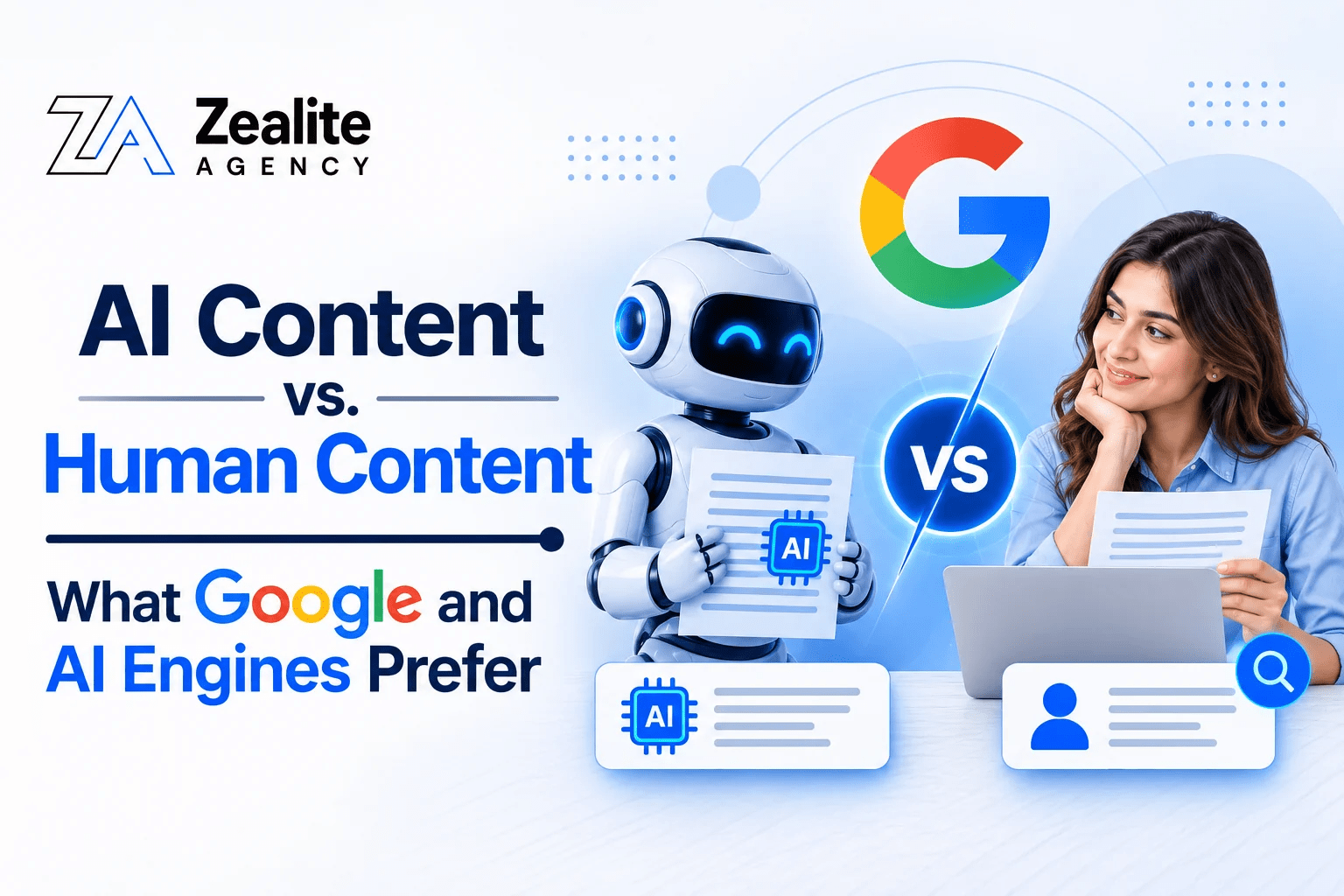
For businesses in the USA, this raises an important question: should content teams rely on AI, human writers, or a combination of both? The answer depends on the purpose of the content and the value it provides. In this blog, we will explore AI content vs. human content, how Google evaluates content quality, what AI-powered search engines look for, and how businesses can create content that earns attention and builds trust.
What is AI-Generated Content?
AI-generated content is text created using artificial intelligence tools that understand prompts and generate responses based on learned information.
Businesses commonly use AI to create:
- Blog outlines and first drafts.
- Product descriptions and website copy.
- Social media captions and email content.
- Frequently asked questions.
- Content summaries and research notes.
- Meta titles and descriptions.
AI saves time when managing multiple content formats. However, it may repeat commonly available information, include incorrect details, or lack practical industry knowledge.
What is Human Written Content?
Human-written content is created by people who bring their knowledge, experience, opinions, and audience understanding into the writing process.
For example, a basic SEO article might explain keywords, backlinks, and website optimization. A writer with practical industry knowledge can also explain how businesses should improve their Google Business Profile, optimize service pages, and evaluate incoming leads.
Key strengths of human-written content include:
- Personal experience: Includes real observations, lessons, and practical examples.
- Audience understanding: Addresses readers’ needs and expectations.
- Original perspectives: Adds unique opinions and insights.
- Context and judgment: Provides relevant explanations and meaningful details.
- Emotional connection: Uses natural storytelling to make information relatable.
However, human writing also requires proper research, editing, and fact-checking to ensure the information is useful and accurate.
Businesses looking for a strong content strategy can also benefit from working with the best SEO agency in USA, where SEO knowledge and human expertise help create content that connects with readers and supports search visibility.
AI Content vs. Human Content: What is the Actual Difference?
The main difference is not simply who or what produces the words. It is the level of understanding, originality, research, and editorial judgment behind the finished content.
The following table highlights the key differences between AI content and human content.
| Comparison | AI Content | Human Content |
|---|---|---|
| Research | Fast information gathering | Detailed, verified research |
| Originality | Pattern based ideas | Unique ideas and insights |
| Writing Style | Prompt based writing | Natural and relatable writing |
| Speed | Faster content creation | Requires more time |
| Accuracy | Needs fact checking | Human review and verification |
| Creativity | Generates ideas from learned patterns | Adds original perspectives |
| Audience Understanding | Limited context | Better understanding of reader needs |
| Personal Experience | Cannot provide genuine personal experiences | Includes real experiences and examples |
| Emotional Connection | May sound generic | Creates a stronger personal connection |
| Accountability | Requires human oversight | Editors take responsibility |
Here are some important differences to consider in more detail.
1. Research and Information
- AI tools can collect and organize ideas quickly, but their responses may contain outdated information or unsupported statements.
- Human writers can examine reliable sources, verify claims, and decide which information deserves attention.
The main difference is that AI helps speed up research, while human judgment ensures the information is accurate and relevant.
2. Originality and Perspective
- AI often produces familiar explanations based on patterns in existing information. Without additional input, several articles on the same subject can sound remarkably similar.
- Human writers can introduce customer experiences, industry observations, original research, and practical examples that make an article more distinctive.
This makes human input important for creating content that offers something different from what readers have already seen.
3. Writing Style and Context
- AI can follow a requested tone, but it may struggle to maintain a genuinely natural voice when the subject requires personal understanding.
- Human writers can recognize subtle differences in audience expectations and adjust the message accordingly.
As a result, human editing helps make content more relatable and consistent with a brand’s communication style.
4. Speed and Productivity
- AI has an advantage when creating outlines, summarizing research, and generating initial drafts.
- Human writing generally requires more time because it involves investigation, planning, and revision.
Combining both approaches allows businesses to save time while maintaining content quality and originality.
5. Accuracy and Accountability
- AI-generated information needs careful verification, as it may include incorrect or outdated details.
- Human editors can review claims, check references, and take responsibility for the information being published.
Neither approach is automatically better. The quality of the final content matters more than the production method.
Compare: Yelp vs. Google Business Profile: Which is Better for Local SEO?
AI Content vs. Human Content: What Does Google Prefer?
Google does not automatically favor human-written content over AI-generated content. Its documented guidance focuses on the quality and usefulness of information rather than the method used to produce it.
According to Google Search Central, AI can be used to create helpful content. However, generating large numbers of pages without adding meaningful value may violate Google’s spam policies.
Google encourages publishers to create original, reliable, and people-first content instead of producing articles primarily to manipulate search rankings.
This means businesses should pay attention to the following factors:
- Helpful information: Does the content answer the reader’s actual question?
- Originality: Does it provide something beyond what readers can find on other websites?
- Experience: Does it demonstrate practical knowledge of the subject?
- Accuracy: Are the facts, statistics, and recommendations properly verified?
- Trustworthiness: Can readers understand who created the content and why they should trust it?
Google’s E E A T framework, which stands for Experience, Expertise, Authoritativeness, and Trustworthiness, also provides useful principles for evaluating content quality. E E A T itself is not a single ranking factor, but these qualities help explain what makes information reliable.
AI Content vs. Human Content: What Do AI Search Engines Look for?
People use AI-powered search to ask questions, compare services, and find direct answers. Businesses should focus on clear, useful, and reliable content.
Here are five important practices:
- Provide Direct Answers: Answer questions clearly before adding details.
- Organize Information: Use descriptive headings, short paragraphs, and relevant FAQs.
- Include Original Insights: Add practical examples, expert opinions, and unique observations.
- Support Important Claims: Use reliable sources for statistics and technical information.
- Maintain Subject Knowledge: Cover relevant topics that demonstrate your website’s expertise.
For businesses investing in local SEO services, these practices help create location-specific pages that answer customer questions instead of repeating generic service descriptions.
Interesting read: GEO vs. SEO vs. AEO: What’s the Difference?
AI Content vs. Human Content: Which One to Choose?
Both AI and human content have their own strengths. The right choice depends on your content goals, audience expectations, and the level of expertise required.
1. When Should Businesses Use AI for Content Creation?
AI can reduce repetitive tasks and give writers more time for research, strategy, and editing.
Businesses can use AI for:
- Generating article outlines: Create structures and identify key subtopics.
- Finding content gaps: Explore questions that need detailed explanations.
- Creating initial drafts: Develop content for writers to review and improve.
- Repurposing existing content: Turn articles into social media posts or email summaries.
- Improving readability: Identify complex sentences and suggest clearer alternatives.
- Preparing content briefs: Organize audiences, topics, keywords, and publishing goals.
However, every important claim should be verified before publication.
For example, businesses offering SEO services for gyms can use AI to brainstorm fitness marketing topics, but recommendations should address membership inquiries, local visibility, and customer retention.
2. When is Human Writing the Better Choice?
Some subjects require deeper understanding and genuine experience. Human involvement is important for:
- Industry expertise: Providing accurate technical explanations and recommendations.
- Customer experiences: Creating genuine case studies and testimonials.
- Brand communication: Reflecting actual company values, services, and style.
- Thought leadership: Sharing original viewpoints and industry insights.
- Sensitive information: Reviewing financial, legal, and health-related content with qualified professionals.
For example, local SEO for HVAC companies requires understanding seasonal demand, emergency searches, service areas, and how homeowners choose contractors.
Similarly, businesses comparing the best SEO company in Cambridge should evaluate actual expertise, strategies, and supporting evidence rather than polished marketing language.
How to Combine AI and Human Writing for Better Results
Businesses do not need to choose between the two approaches. A well-planned workflow can use AI for efficiency while keeping people responsible for originality, accuracy, and editorial quality.
Here is a practical process to follow:
Step 1: Understand the Audience
Identify readers, their challenges, and search intent.
Step 2: Research the Topic
Review reliable sources, competitor content, customer questions, and industry trends.
Step 3: Prepare an Outline
Use AI to organize ideas, then let a human editor select relevant sections.
Step 4: Develop the Content
Add researched explanations, practical examples, and original perspectives.
Step 5: Review the Content
Verify facts, remove repetition, improve readability, and check accuracy.
Step 6: Optimize for Search
Add relevant keywords, descriptive headings, internal links, and accurate metadata.
Businesses targeting multiple markets may also need international SEO services to address language differences, regional search behavior, and location-specific content requirements.
Step 7: Publish and Evaluate
Monitor impressions, clicks, engagement, and conversions to identify areas for improvement.
Common Content Mistakes Businesses Should Avoid
Even well-written articles can underperform without proper planning and editing.
Avoid these common mistakes:
- Publishing without editing: AI drafts may contain repetition, vague explanations, and factual errors.
- Writing only for keywords: Repeating search terms without answering readers’ questions affects readability.
- Copying competitor structures: Reusing existing ideas offers little originality.
- Using fake examples: Never present invented customer experiences or results as genuine.
- Ignoring search intent: Different searches require different types of content.
- Publishing too frequently: Maintain consistency without sacrificing quality.
A professional seo company should treat content as part of a wider strategy connecting audience needs, website relevance, and business objectives.
Suggested read: How an SEO Company Helps Your Brand Stand Out Online
How Zealite Agency Balances AI and Human Content for SEO
Good content goes beyond adding keywords or publishing articles regularly. It should answer readers’ questions, share useful insights, and build trust.
At Zealite Agency, we use AI to support content creation while keeping human creativity at the centre. Our approach includes:
- Understanding readers: Researching audience interests, common questions, and search intent.
- Planning content: Exploring relevant topics and identifying content gaps.
- Adding human insight: Bringing originality, industry knowledge, and a natural writing style.
- Improving SEO: Using relevant keywords naturally without affecting readability.
- Reviewing quality: Checking facts, clarity, and usefulness before publication.
Our digital marketing experts combine creative thinking with practical SEO strategies to help businesses publish meaningful content, improve online visibility, and build lasting audience trust.
Conclusion
The discussion around AI content vs. human content is not about choosing one over the other. AI helps save time, organize ideas, and handle repetitive tasks, while human writers bring creativity, experience, and originality. Combining both can deliver better results.
For businesses in the USA, the priority should be creating useful, trustworthy content that answers real questions and meets audience expectations. Ultimately, helping readers should matter more than simply filling search results.
Frequently Asked Questions About AI Content vs. Human Content
1. Does Google penalize AI-generated content?
No. Google doesn’t automatically penalize AI content, but low-quality content created to manipulate rankings can violate its spam policies.
2. Is human-written content better for SEO?
Not necessarily. Human-written content can offer original insights and practical experience, but it must still be accurate, relevant, and useful to perform well.
3. Can AI-generated blogs rank on Google?
Yes. AI-assisted or generated blogs can rank when they provide original, helpful, accurate information and meet Google’s quality expectations.
4. Does AI content affect website indexing?
AI usage alone does not prevent indexing. However, poor quality, duplicate, or unhelpful pages may struggle to gain search visibility.
5. Can AI content appear in AI search results?
Yes. AI-assisted content can be referenced in AI search experiences when it provides relevant and useful information. No particular writing method guarantees inclusion.
6. Should businesses disclose AI-generated content?
Disclosure is not required in every situation. However, explaining how automation was used can help readers understand the content when that information is relevant to them.
7. How can we make AI content sound more natural?
Add original examples, verify information, remove repetitive explanations, use a consistent brand voice, and edit the draft with the target audience in mind.
8. Is AI useful for keyword research and content planning?
Yes. AI can help brainstorm topics, organize keyword ideas, and prepare content outlines. Keyword selection should still be validated using reliable SEO research tools.
9. How often should businesses update their website content?
There is no fixed schedule. Review content whenever information becomes outdated, services change, search intent shifts, or performance indicates that improvements are needed.
10. What is the best content strategy for long-term SEO?
Focus on useful information, original insights, accurate research, clear website structure, and regular content reviews. Use AI to improve efficiency without sacrificing editorial quality.