Have you ever wondered why some websites get noticed on Google while others struggle, even after publishing blogs regularly? The difference is not always about keywords, backlinks, or how often a website publishes new content. It often comes down to what readers actually get from that content. When people see several articles on the same topic, they are more likely to trust the one that shares useful information, real experiences, and honest insights rather than simply repeating what everyone else has already said.
For businesses competing in the USA, building that confidence has become an important part of a sustainable search strategy. Google’s approach to evaluating content quality places considerable attention on experience, expertise, authoritativeness, and trustworthiness, commonly known as E-E-A-T. In this blog, we explore how E-E-A-T influences SEO in 2027, why trust matters in content creation, and what website owners can do to make their pages more useful, credible, and valuable to readers.
What is E-E-A-T in SEO?
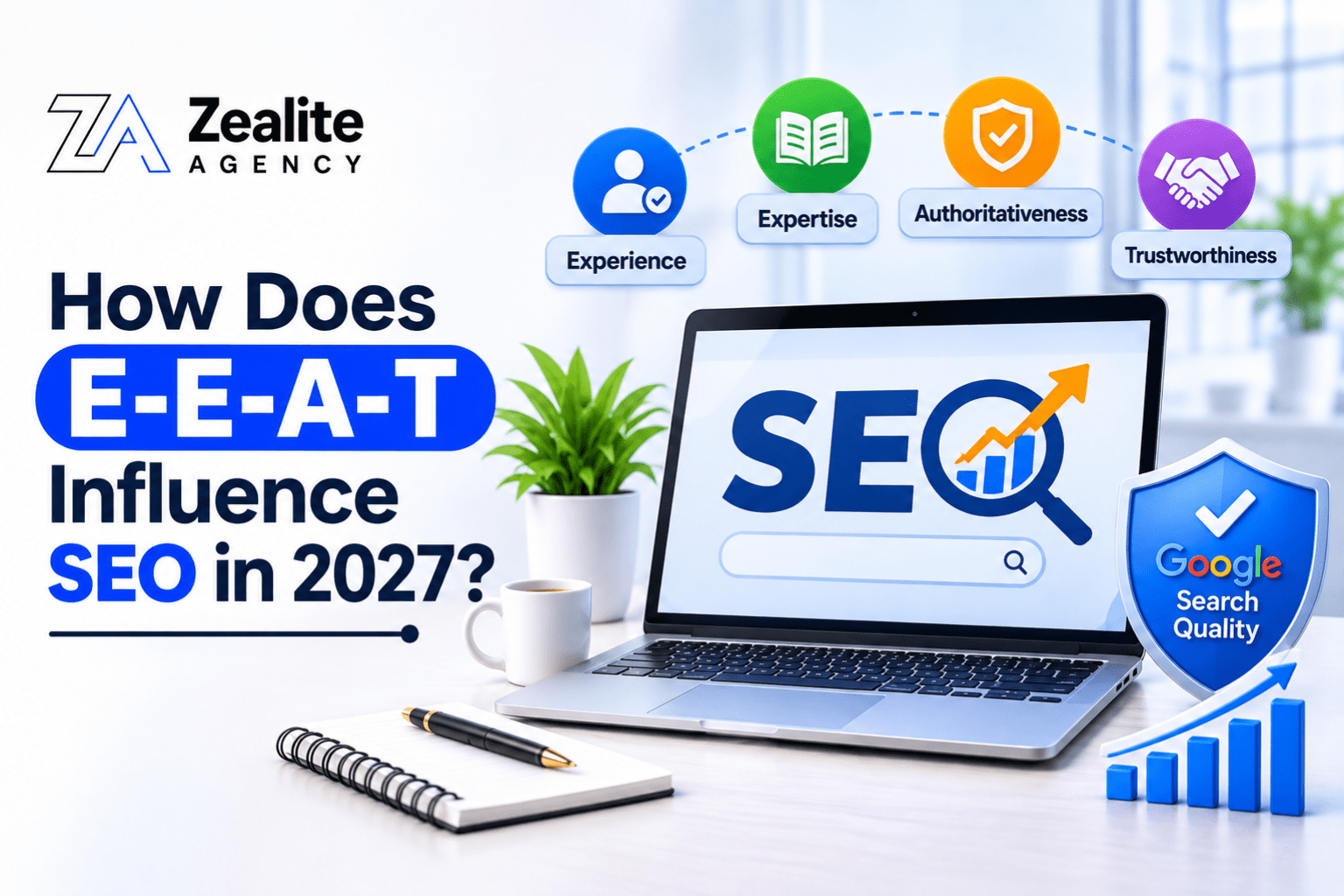
E-E-A-T stands for Experience, Expertise, Authoritativeness, and Trustworthiness. It is a concept included in Google’s Search Quality Rater Guidelines to help human quality raters assess the quality of search results.
Each element represents a different aspect of content quality and website credibility.
1. Experience
Experience refers to the first-hand knowledge a content creator has about the subject. Readers often find information more useful when it comes from someone who has actually used a product, completed a process, visited a location, or handled a particular situation.
For example, an article about managing a local business website can offer more practical value when it includes lessons from real SEO campaigns, common challenges, and actual observations rather than simply repeating information available elsewhere.
2. Expertise
Expertise relates to the knowledge and skills required to explain a particular subject accurately. It is especially important when content covers technical, financial, legal, medical, or other subjects where incorrect information could affect people’s decisions.
An article about search engine optimization, for instance, should explain concepts correctly, use reliable information, and provide recommendations that readers can understand and apply.
3. Authoritativeness
Authoritativeness reflects how a website, author, or organization is recognized as a reliable source within a particular subject area.
A website can develop authority by consistently publishing useful information, earning relevant references from reputable sources, demonstrating subject knowledge, and maintaining a clear identity.
4. Trustworthiness
Trustworthiness is the foundation of E-E-A-T. It considers whether readers can rely on the website, its authors, and the information it provides.
Clear contact details, accurate claims, transparent business information, secure browsing, updated content, and properly attributed sources can all help establish trust.
Among these four elements, trust is particularly important because even knowledgeable content may lose credibility if readers cannot verify who published it or whether its claims are accurate.
Businesses investing in SEO services in USA can benefit from this approach by making content quality and search visibility part of the same strategy.
How Does E-E-A-T Influence SEO in 2027?
E-E-A-T influences SEO by providing a useful framework for understanding what makes content helpful, credible, and reliable. However, it is important to understand one distinction: E-E-A-T is not a single direct Google ranking factor with a measurable score.
Google uses multiple automated systems to identify helpful and relevant content. Its quality raters use E-E-A-T concepts to evaluate search results and provide feedback on how well Google’s systems are working. Their individual ratings do not directly change the ranking of a particular website.
So, how does this concept affect an SEO strategy?
It encourages website owners to focus on the qualities that help search engines identify useful information and help people make informed decisions.
Here are some important ways E-E-A-T can influence an SEO strategy in 2027.
1. Encourages More Useful and Original Content
Publishing content simply to target a keyword is no longer a sensible long-term strategy. Readers expect information that answers their questions, explains unfamiliar concepts, and helps them solve actual problems.
For example, a generic article about local SEO may explain what local search means. A more useful article could discuss how businesses manage their Google Business Profile, improve location pages, handle customer reviews, and measure local search performance.
The second approach gives readers practical information instead of repeating basic definitions.
2. Helps Establish Credibility in Competitive Niches
When multiple websites publish information about the same topic, credibility can help distinguish one source from another.
Consider a cleaning business that wants to attract customers through organic search. A website containing only service descriptions may provide limited information to potential customers.
However, publishing practical cleaning guides, explaining service procedures, sharing genuine customer experiences, and answering common questions can give visitors more reasons to trust the business.
This is where cleaning company SEO experts can help develop a content strategy that communicates real service knowledge rather than relying entirely on keyword-focused pages.
3. Supports Better Content Quality Signals
Google’s systems aim to identify content that is relevant, useful, and created primarily to help people.
Although E-E-A-T does not work as a standalone ranking score, its principles encourage practices that support better content quality, such as:
- Providing accurate and well-researched information.
- Explaining topics with sufficient detail.
- Identifying content authors where appropriate.
- Updating outdated information.
- Avoiding exaggerated or unsupported claims.
- Giving readers practical examples and useful explanations.
These practices can improve the overall quality of a website and create a better experience for visitors.
4. Make Trust an Important Part of Conversion
SEO success should not be measured only by how many visitors reach a website. What happens after someone arrives also matters.
Imagine a potential customer searching for a digital marketing service. They visit two websites offering similar services. One has vague descriptions, no identifiable team, and little information about its work. The other explains its approach, provides useful resources, and makes its business details easy to find.
The second website gives visitors more reasons to feel confident before enquiring.
This shows how trust can support the relationship between organic visibility, user experience, and business conversions.
5. Gives Greater Importance to Author Transparency
Readers should be able to understand who created the information they are reading and why that person or organization is qualified to discuss the subject.
A website can improve transparency by including:
- Author names and relevant professional backgrounds.
- Links to detailed author biographies.
- Information about the business or organization behind the website.
- References to reliable research and sources.
- Clear editorial and content review practices.
For example, an article discussing website security should ideally be written or reviewed by someone with relevant technical knowledge. Similarly, financial advice should come from appropriately qualified professionals.
Author transparency does not automatically improve rankings, but it helps readers evaluate the reliability of information.
6. Reinforces the Importance of Relevant Backlinks and Reputation
A website’s reputation is not built entirely through its own content. What other credible sources say about a business or organization can also contribute to how people perceive it.
Relevant mentions, genuine industry references, professional contributions, and editorial backlinks can help establish recognition within a particular field.
However, collecting backlinks from unrelated websites simply to increase link numbers does not establish genuine authority.
A better approach includes:
- Publishing original research, insights, or useful resources.
- Contributing knowledgeable comments to relevant industry publications.
- Building relationships with reputable businesses and professionals.
- Creating content that other websites have a genuine reason to reference.
- Maintaining consistent and accurate business information.
An established SEO agency should consider reputation building as part of a broader search strategy rather than treating link acquisition as an isolated activity.
Why is E-E-A-T Important for AI Search and Traditional SEO?
Search behavior is changing. People still use traditional search engines to discover information, but they are also turning to AI-powered search experiences to understand topics, compare solutions, and find answers.
This makes content quality and credibility important considerations for businesses that want to maintain visibility across different discovery channels.
When considering AI content or human content, the more useful question is whether the final material provides accurate, original, and helpful information.
Here are three areas businesses should consider.
1. Original Information Matters More Than Repeated Explanations
AI tools can summarize information from existing sources, but a summary alone may not provide much additional value.
Suppose a business publishes an article about improving website conversion rates. Instead of repeating common suggestions, it could explain actual website problems, discuss different approaches to resolving them, and share observations from practical work.
That additional information gives readers something they may not find in every other article.
2. Accuracy Helps Build Confidence
AI-generated information can sometimes contain outdated statistics, incorrect explanations, or references that do not support the claims being made.
For this reason, content should be checked before publication.
A practical review process should include:
- Checking important facts against sources.
- Confirming that statistics are current.
- Reviewing technical explanations.
- Removing unsupported claims.
- Ensuring examples accurately represent the subject.
- Checking whether the content answers the intended search query.
3. Clear Context Makes Content Easier to Evaluate
Readers should understand where information comes from and how it was developed.
For example, an article based on industry research should identify the research source. A product comparison should explain the criteria used. A case study should provide enough context for readers to understand the results.
These details make information more transparent and useful.
Compare: SEO vs AEO vs GEO: Strategies for Better Search Visibility
8 Practical Ways to Improve E-E-A-T on Your Website
Understanding the concept of the E-E-A-T guideline is useful, but applying it consistently is what makes a difference to website quality.
The following practices can help businesses strengthen their content and establish greater credibility.
1. Publish Content Based on Real Experience
Avoid creating articles that only repeat information from competing websites.
Instead, include examples, observations, practical explanations, and lessons that demonstrate a genuine understanding of the subject.
For example, a company offering website development services could publish an article explaining common checkout problems, how they affect customers, and what businesses should consider when resolving them.
If you are managing a business website, include relevant details about your actual services and processes rather than making broad claims that could apply to any company.
2. Create Detailed and Accurate Author Profiles
An author profile helps readers understand who is responsible for the content.
A useful author biography can include:
- Professional background.
- Relevant qualifications or certifications.
- Areas of specialization.
- Industry experience.
- Links to other published articles or professional profiles.
Only include qualifications and experience that can be verified. Creating fictional expert profiles to make content appear more credible can damage trust.
3. Keep Important Website Pages Updated
An outdated website can create confusion, particularly when it contains old statistics, discontinued services, broken links, or inaccurate business information.
Review important pages periodically and update them whenever meaningful changes are required.
For example, a digital marketing article published two years ago may need revisions if its explanation of search features, tools, or recommended practices is no longer accurate.
Do not change publication dates simply to make old content appear new. Update the date when a substantial revision has genuinely taken place.
4. Use Reliable Sources and Support Your Claims
Research is an important part of producing credible content.
When discussing industry changes, technical subjects, or statistics, refer to sources that readers can verify.
Useful sources include:
- Official Google Search Central documentation.
- Government websites and publications.
- Academic research.
- Industry reports from recognized organizations.
- Original research and relevant case studies.
Avoid presenting assumptions as facts. If a statement is based on an estimate or personal observation, make that clear.
5. Build a Consistent Content Strategy Around Your Industry
Publishing content about unrelated subjects can make it difficult for visitors to understand what a website specializes in.
A focused content strategy helps businesses cover the subjects that matter to their audience.
For example, a digital marketing website can create related content around SEO, paid advertising, website optimization, content marketing, and local search.
A business working with SEO companies in Gainesville can also evaluate how effectively those companies cover relevant topics, demonstrate their knowledge, and provide useful information to local businesses.
The objective should be to build meaningful subject coverage, not simply publish as many articles as possible.
6. Make Your Website Information Transparent
Trust is not limited to blog content. The rest of the website also influences how visitors perceive a business.
Make sure your website includes:
- A detailed About Us page.
- Accurate business contact information.
- Clear descriptions of services.
- A privacy policy and relevant legal information.
- Genuine customer testimonials, where available.
- Clear details about the business location and service areas.
If your business serves customers across the USA, make your service coverage clear instead of implying that you operate in locations where you do not provide services.
7. Improve the Overall User Experience
Even informative content can become difficult to use when a website has poor navigation, intrusive pop-ups, slow-loading pages, or confusing layouts.
Visitors should be able to find the information they need without unnecessary effort.
Pay attention to:
- Mobile responsiveness.
- Readable font sizes.
- Clear heading structures.
- Logical internal linking.
- Fast page loading.
- Accessible navigation.
- Properly displayed images and media.
A local SEO company should also consider how location pages, contact information, and business details work together to create a consistent experience for local visitors.
8. Review Your Content Before Publishing
A final editorial review can prevent many quality issues.
Before publishing an article, check whether it provides something useful beyond what readers can already find elsewhere.
Here is a simple review checklist:
- Does the article answer the main search query?
- Is the information accurate and relevant?
- Does it include original insights or practical examples?
- Are the author and source details clear?
- Are the keywords placed naturally?
- Are internal links relevant to the surrounding content?
- Does the article avoid exaggerated claims?
- Is the formatting easy to read?
- Are spelling and grammatical errors corrected?
This process helps maintain consistency across your website.
How Can Businesses Measure Their E-E-A-T Progress?
One common misunderstanding is that businesses can measure E-E-A-T through a specific score in Google Analytics or Google Search Console.
There is no official E-E-A-T score that website owners can track.
Instead, businesses can monitor indicators that help them understand whether their website is becoming more useful, credible, and recognizable.
Consider tracking these five areas:
| Area | What to Monitor |
| Organic visibility | Search impressions, clicks, and relevant keyword performance |
| Content engagement | Engagement patterns and visitor interactions |
| Website credibility | Genuine mentions, relevant backlinks, and brand references |
| Author transparency | Author profiles, editorial information, and source attribution |
| Technical experience | Mobile usability, loading performance, and indexing issues |
Tools such as Google Search Console and Google Analytics can help evaluate search performance and visitor behavior.
You can also use top SEO tools to research keywords, review backlinks, identify technical issues, and compare your content with competing pages.
Common E-E-A-T Mistakes That Websites Should Avoid
Even businesses that understand Google’s E-E-A-T guidelines can make mistakes when trying to demonstrate credibility.
Here are some issues worth avoiding.
- Adding Keywords Without Providing Useful Information: Overusing keywords instead of focusing on readers’ needs.
- Publishing AI Content Without Proper Review: Publishing generic or inaccurate content without fact-checking.
- Creating Fake Author Credentials: Using misleading author profiles or unverified qualifications.
- Treating Backlinks as the Only Sign of Authority: Prioritizing link quantity over relevance and quality.
- Updating Content Only to Change Its Publication Date: Changing dates without making meaningful improvements.
- Making Unsupported Marketing Claims: Using exaggerated promises or unverified business results.
How Zealite Agency Implements E-E-A-T in Its SEO Strategy
At Zealite Agency, we believe sustainable SEO starts with understanding audience needs and creating content that genuinely helps people make informed decisions.
For businesses targeting customers across the USA, content should do more than attract traffic. It should answer relevant questions, explain services clearly, and build trust with potential customers. Following Google’s E-E-A-T guidelines helps us maintain these priorities and create more credible content.
Our SEO approach focuses on:
- Audience-focused content: Understanding search intent and customer needs.
- Relevant keyword placement: Using keywords naturally without affecting readability.
- Content accuracy: Prioritizing reliable information and regular content reviews.
- Website optimization: Improving technical performance, internal linking, and mobile usability.
- Local search visibility: Creating relevant location-focused content and maintaining accurate business information.
- Continuous improvement: Monitoring performance and identifying opportunities for improvement.
Whether a business works with the best SEO company or manages its website internally, applying E-E-A-T principles can help build a credible online presence.
As a trusted internet marketing agency in USA, Zealite Agency focuses on meaningful content, website quality, and building lasting trust with audiences.
Conclusion
E-E-A-T guidelines play an important role in understanding content quality and website credibility. Although it is not a direct Google ranking factor, its principles help businesses focus on useful information, genuine expertise, accurate content, and reader trust. Understanding how E-E-A-T influences SEO can help website owners create content that serves people rather than simply targeting keywords.
As SEO continues to evolve in 2027, businesses should prioritize original insights, reliable information, and a positive user experience. Consistently delivering genuine value gives a website a stronger foundation for building trust, attracting relevant visitors, and maintaining long-term search visibility.
Frequently Asked Questions
1. Is E-E-A-T a direct Google ranking factor?
No. E-E-A-T is not a direct Google ranking factor or a measurable score. However, Google uses various systems to identify helpful, reliable content. Its principles help website owners improve content quality, demonstrate credibility, and build reader trust.
2. How Do Author Profiles Support E-E-A-T?
Author profiles help readers understand who created the content and their relevant experience. Including professional backgrounds, genuine qualifications, areas of expertise, and links to published work improves transparency and helps readers evaluate the credibility of information.
3. What is the difference between E-A-T and E-E-A-T?
E-A-T stands for Expertise, Authoritativeness, and Trustworthiness. Google added another E for Experience in December 2022. This updated framework recognizes the importance of first-hand knowledge and practical experience in creating useful and reliable content.
4. Does AI-generated content affect E-E-A-T?
AI-generated content does not automatically have poor E-E-A-T. Google focuses on content quality, accuracy, and usefulness rather than how content is produced. However, unreviewed AI content containing errors, misleading claims, or repetitive information can reduce its value.
5. How can small businesses improve E-E-A-T?
Small businesses can improve E-E-A-T by publishing original industry insights, sharing genuine customer experiences, maintaining accurate business information, creating author profiles, and regularly reviewing website content. These practices help demonstrate expertise, improve transparency, and establish customer trust.
6. Can backlinks improve website authority and E-E-A-T?
Relevant backlinks and genuine mentions from reputable websites can strengthen a business’s online reputation. However, backlink quantity alone does not establish authority. Focus on earning meaningful references through quality content, industry contributions, and relationships with relevant sources.
7. How often should businesses update their content to maintain E-E-A-T?
There is no fixed schedule for updating content. Businesses should review their pages whenever information becomes outdated, industry practices change, or corrections are needed. Meaningful updates help maintain accuracy, relevance, and usefulness for readers.
8. How can we check whether our website demonstrates E-E-A-T?
There is no official E-E-A-T score or dedicated measurement tool. Businesses can review author profiles, content accuracy, original insights, website reputation, and reliable sources. Google Search Console can also help monitor organic visibility and search performance.
9. Does E-E-A-T Apply to Every Website?
Yes. E-E-A-T principles apply to blogs, business websites, ecommerce stores, and informational platforms. Every website can benefit from publishing accurate information, demonstrating relevant knowledge, sharing genuine experiences, and providing a transparent and trustworthy experience.
10. What Role Does Content Quality Play in E-E-A-T?
Content quality is essential to demonstrating E-E-A-T. Accurate, original, and well-researched information helps demonstrate expertise, build reader confidence, and provide practical insights. Content should answer user questions clearly and offer genuine value rather than simply targeting keywords.